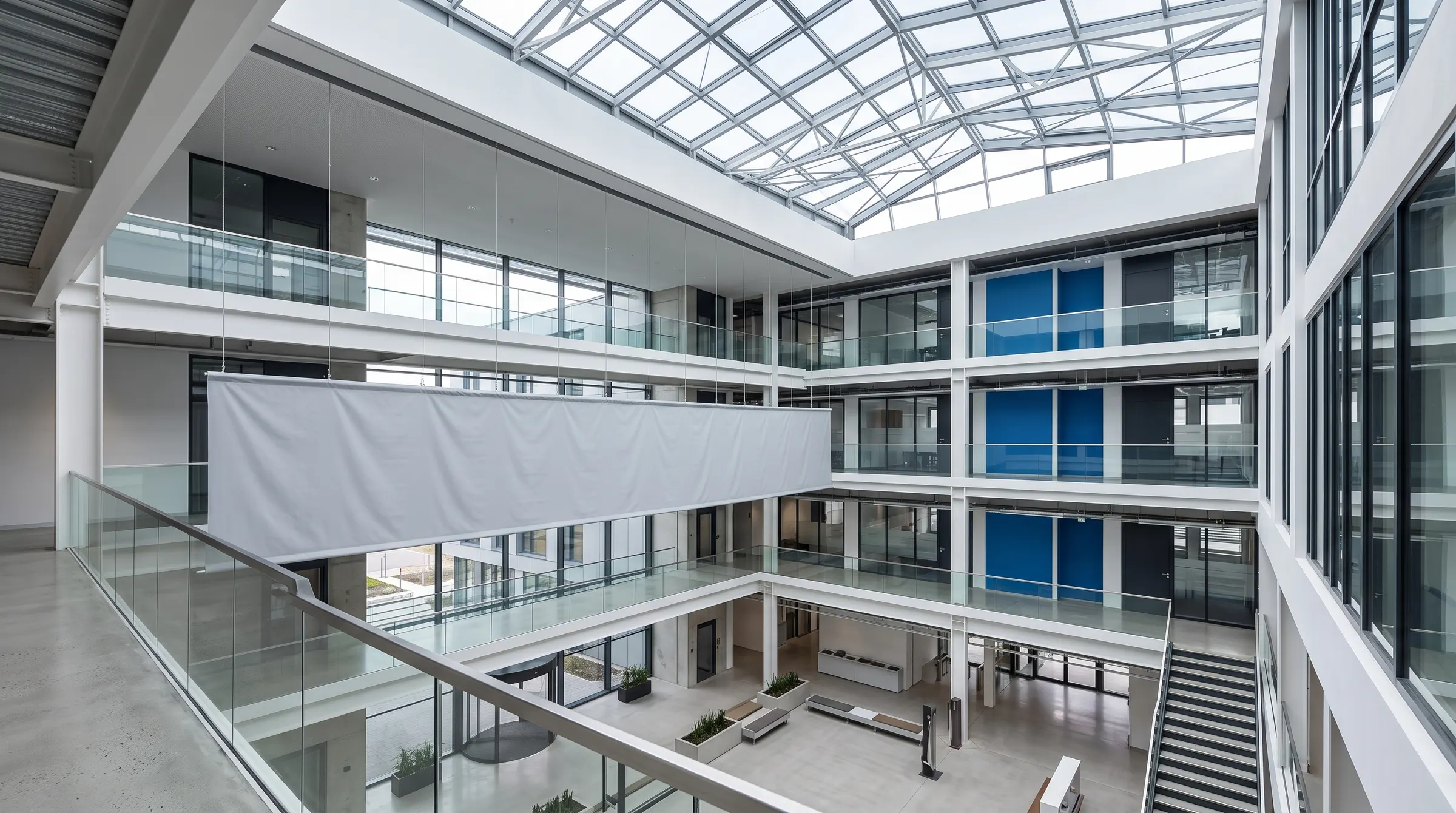
Fire safety information
Fire safety starts with limiting the spread of fire and smoke. Fire curtains and smoke curtains play a key role in this: they divide a building into compartments in case of fire. On this page you will find the most important concepts, standards and rules at a glance — for architects, consultants, contractors and building owners dealing with compartmentation.
Fire curtain
A fire curtain is a roll-down curtain of heat-resistant fabric that closes automatically in case of fire and seals off an opening in a wall, facade or passage in a fire-resistant way. It holds back flames and hot smoke gases — depending on the classification also heat radiation and heat transfer — and thus restores the compartmentation.
Smoke curtain
A smoke curtain is a roll-down or fixed curtain that limits the spread of smoke in a building. On detection it descends automatically and holds back smoke and hot smoke gases, so escape routes remain usable and smoke can be extracted in a controlled way.
Fire compartmentation
Fire compartmentation is the division of a building into spaces that keep fire and smoke within their boundaries for a prescribed period. Compartmentation limits damage, gives occupants time to escape and gives the fire brigade a chance to keep the fire under control.
Which standards apply to fire and smoke curtains?
EN 1634-1EN 1634-3EN 13501-2EN 12101-1
Our fire curtains are tested to EN 1634-1 and classified to EN 13501-2, with classifications from E 120 to EI 120 depending on the model. Our smoke curtains follow a different route: they are tested and classified as DH and DHA smoke barriers to EN 12101-1. Smoke leakage (Sa or S200) is a separate performance — tested to EN 1634-3, classified to EN 13501-2 — that must be demonstrable for each curtain construction. All curtains are tested and certified for use within the European market.
What do the classifications E, EW and EI mean?
EEWEI
The letters describe what a separation holds back, the number for how many minutes. E (integrity) means flames and hot gases are held back, with no requirements on temperature or heat radiation. EW additionally limits the heat radiation at 1 metre from the unexposed side to at most 15 kW/m². Instead of that radiation limit, EI sets requirements on the temperature rise on the unexposed side — on average no more than 140 °C — distinguishing between EI₁ and EI₂ depending on the element. Our range includes classifications from E 120 to EI 120, depending on the model; the separate Sa marking denotes smoke leakage at ambient temperature and is a performance to be demonstrated separately.
What do the smoke classifications Sa, S200, DH and DHA mean?
SaS200DHDHA
With smoke, two routes run in parallel. Sa and S200 are product classifications for smoke leakage: Sa at ambient temperature, S200 also at 200 °C, tested to EN 1634-3 and classified to EN 13501-2. DH and DHA apply to smoke barriers used to EN 12101-1 within a smoke and heat control system; DHA stands for more than 120 minutes. In the Netherlands the Bbl additionally requires resistance to smoke passage to NEN 6075, using the classes Ra and R200 — these are not the same as Sa and S200 and apply to the whole separation, not to the product alone.
What does the Dutch Building Decree (Bbl) require?
The Dutch Building Decree (Besluit bouwwerken leefomgeving, Bbl) requires buildings to be divided into fire compartments and sets requirements for the resistance to fire penetration and fire spread (WBDBO) between those compartments. If a design deviates — for example with an open atrium — the equivalence principle offers room: with measures such as fire and smoke curtains you demonstrate that the same level of safety is achieved.
Fire curtain or smoke curtain: what does your building need?
| Criterion | Fire curtain | Smoke curtain |
|---|---|---|
| Holds back | Flames and hot smoke gases; EW and EI versions also limit heat radiation and heat transfer | Smoke and hot smoke gases |
| Typical classification | E 120, EW or EI to EN 13501-2 — depending on model and project requirement | DH or DHA to EN 12101-1 |
| Typical application | Compartment separation, facades, industry and logistics | Atriums, voids, escalators and escape routes |
| Suitable for | Openings that must form a compartment separation in case of fire: passages, facades and large spans | Spaces where smoke must be contained and escape routes must remain usable: atriums, voids and corridor zones |
View the related products: fire curtain and smoke curtain.
Frequently asked questions about fire and smoke curtains
A fire curtain holds back flames and hot smoke gases and forms a compartment separation in case of fire; depending on the classification it also limits radiation and heat transfer. A smoke curtain only holds back smoke and hot smoke gases and serves to contain smoke spread and keep escape routes usable. Many buildings combine both.
That is determined by the classification: the number after the letters indicates how many minutes the curtain retains its function, usually 30, 60, 90 or 120 minutes. The required duration follows from the building regulations (Bbl) and the building's fire safety concept. Our range includes fire curtains from E 120 to EI 120, depending on the model.
The Bbl does not prescribe curtains as such, but it does require fire compartmentation and a certain resistance to fire penetration and fire spread. If a design cannot meet this structurally — for instance with an atrium or a large passage — a fire curtain is a recognised way to still meet the requirements through equivalence.
The duty of care in the Dutch building regulations (Bbl) requires that a fire or smoke curtain demonstrably keeps working. Common practice is an annual inspection and service by a specialised company, supplemented by periodic function tests via the fire alarm system. At handover you receive a logbook in which inspections and maintenance are recorded.
Yes. Particularly in existing buildings, roll-down curtains are often the most practical solution, because they require little installation space and no major structural work. After a site survey the curtain is custom-designed for the available space, so installation can take place with minimal disruption.
The price depends on the dimensions, the required classification, the model and the installation situation; a smoke curtain is usually more economical than an insulating EI curtain. A concrete figure therefore always requires a tailored assessment. Request a no-obligation quote — you will receive a price based on your drawings or a site survey.